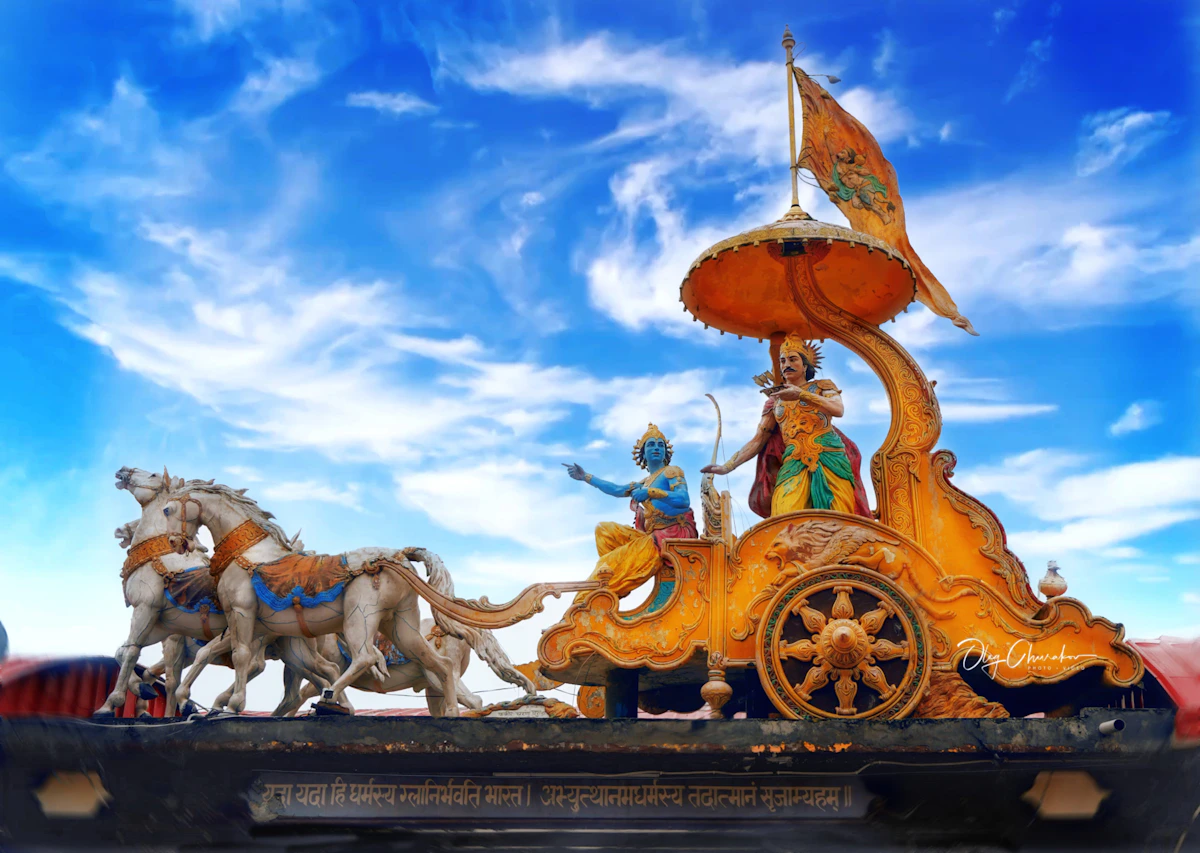
Arjuna is arguably the most accomplished warrior of his generation. He has trained for decades, earned the endorsement of gods, and stands at the head of a righteous cause. And then, at the moment of maximum consequence, he collapses. His bow drops from his hands. He cannot move. He is undone not by an external enemy, but by the weight of his own thinking.
If you have led a team through a difficult decision, restructured an organisation, or sat in a room where the right choice was clear but the personal cost of making it unbearable — you have been Arjuna. The battlefield changes. The paralysis does not.
Lesson One: Clarity of Purpose Precedes Courage of Action
Arjuna's paralysis was not cowardice. It was a crisis of purpose. He had lost sight of why the war mattered, overwhelmed by who would be hurt. Krishna's entire response in the Gita is not tactical — it is purposive. He does not give Arjuna a battle plan. He gives him a reason to fight.
In my experience working with leadership teams, most execution failures are not failures of capability or strategy. They are failures of purpose clarity. When a team is uncertain about why something matters, no amount of process or incentive closes the gap. The leader's first job, in any difficult season, is to hold purpose steady when everything else is shaking.
Lesson Two: The Hardest Decisions Involve People You Know
Arjuna was not afraid of fighting strangers. He was afraid of fighting his own teachers, cousins, and mentors. This is precisely why corporate restructuring, performance management, and difficult feedback are so much harder than any strategic framework suggests. The theory is simple. The practice involves real people with whom you have history.
Leaders who pretend this complexity does not exist — who execute "hard decisions" without acknowledging their human weight — tend to break organisations in ways that take years to repair. The Gita does not ask Arjuna to become indifferent to his opponents. It asks him to act with clarity despite his attachment. There is a meaningful difference.
"The leader's task is not to eliminate doubt. It is to act with clarity in spite of it — and to hold the purpose of the organisation steady while others are overwhelmed by the noise."
— Kuldeep Verma, Nexora ConsultingLesson Three: Role Clarity Is Not Rigidity
The concept of svadharma — one's own duty, aligned with one's nature and role — is at the heart of Krishna's argument. Arjuna is a warrior. His dharma is to fight this particular war. Not to fight all wars, not to impose his dharma on others, but to fulfil the role that is uniquely his in this moment.
For leaders, this translates into a question that sounds simple but rarely is: what is actually my job here? Founders who cannot let go of operational decisions. Senior managers who should be coaching but are instead doing. Boards that drift into management and managers who drift into strategy. Role confusion is epidemic in growing organisations — and the Mahabharata identified it as a root cause of dysfunction 3,000 years ago.
Lesson Four: Detachment from Outcome Is Not Indifference to Quality
Perhaps the most misunderstood instruction in the Gita: do your duty without attachment to the fruits of action. This is routinely misread as an endorsement of passivity or indifference. It is the opposite. It is a prescription for sustained, high-quality effort uncorrupted by anxiety about results.
The leader who is overly attached to a specific outcome becomes rigid, resistant to feedback, and ultimately less effective. The leader who acts with full commitment but holds outcomes lightly is capable of sustained performance across multiple cycles of success and failure. This is not philosophy. It is practical psychology — and it is the difference between leaders who peak early and those who compound over decades.
Lesson Five: Counsel Is Not Weakness
Arjuna asked for help. At the peak of his crisis, the greatest warrior of his generation turned to his charioteer — who happened to be an avatar of the divine — and said: I am confused. Guide me. This moment of acknowledged vulnerability is what makes the Gita possible.
In Indian corporate culture, there is still a pervasive reluctance among senior leaders to seek counsel, coaching, or perspective. It is seen as admitting weakness. The Mahabharata's most celebrated moment of leadership begins with the exact opposite posture. The willingness to say "I do not know, help me think" is not a leadership failure. It is a leadership prerequisite.
Lesson Six: Every Leader Eventually Faces Their Kurukshetra
The battlefield of Kurukshetra was not chosen — it was arrived at through a long sequence of smaller decisions, compromises, and missed opportunities for resolution. By the time the armies faced each other, the war was no longer avoidable.
Most organisational crises work the same way. The restructuring that "came from nowhere" was preceded by two years of signals that were uncomfortable to act on. The talent exodus that "surprised everyone" was forecast by every engagement survey for three years running. The competitor who "came out of nowhere" was visible in the periphery for a decade before anyone in the leadership team took them seriously.
Kurukshetra is often the consequence of avoiding earlier, smaller battles. The leader who develops the courage to address discomfort early — in performance, in strategy, in relationships — rarely has to face a full-scale war.
Want to discuss this for your organisation?
Nexora works with leadership teams navigating exactly these challenges — from strategy to capability building. Let's have a straight conversation.
Start a Conversation →